Detailed analysis of the Lazard 2025 “Cost of Firming Intermittency” in U.S.A., and comparision with Europe
Download the Study here in English : Nenuphar Advisors – LCOE_Jul_2025_v2_BESS_EN
Download the Study here in Portuguese : Nenuphar Advisors – LCOE_Jul_2025_v2_BESS
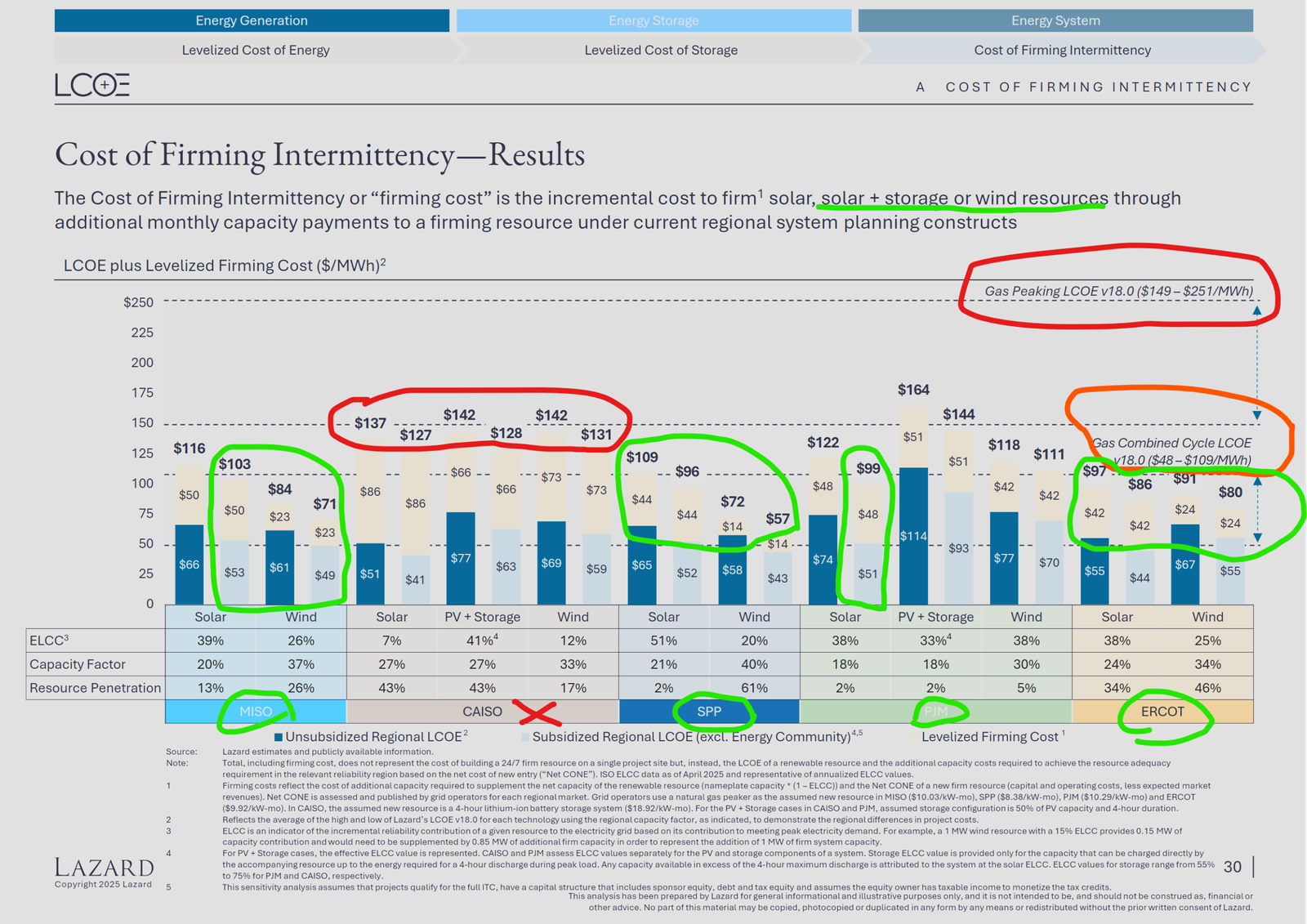
Objective of the Chart
To show how much it costs, on average, to deliver firm (dispatchable) power using renewables (Solar, Wind, Solar+Storage, Wind+Storage) with capacity backup, compared to Gas Peakingand Gas Combined Cycle (CCGT)plants.
Key Takeaway (Green highlights):
In ERCOT, MISO, SPP, and PJM
Wind + Storageand Solar + Storageoften yield LCOE + Firming Cost lower or competitivewith:
Gas Peakers($149–251/MWh)
And often even Gas CCGTs($48–109/MWh)
TECHNOLOGY-BY-TECHNOLOGY INSIGHTS:
1. Solar + Storage
LCOE+Firming in MISO:~$86/MWh
SPP:~$66
PJM:~$66
ERCOT:~$73
CAISO:~$164
Conclusion: Except for CAISO, Solar+Storage is now clearly competitivewith CCGTs and far cheaper than Gas Peakers.
2. Wind + Storage
LCOE+Firming in MISO:~$71
SPP:~$66
PJM:~$73
ERCOT:~$72
CAISO:~$144
Conclusion: Wind+Storage consistently undercuts Gas Peakers and CCGTsin all markets except CAISO. MISO and SPP perform best.
3. Standalone Solar or Wind(without firming)
Even cheaper (e.g., Wind in MISO ~$61/MWh total), but lacks full dispatchability.
Firming cost adds only a modest premium(≈ $20–$30/MWh).
COMPARISON TO GAS:
Gas Peaking (Red circle):
LCOE: $149–$251/MWh→ Renewables + storage always cheaper, even with firming.
Gas Combined Cycle (CCGT) (Orange circle):
LCOE: $48–$109/MWh
Only in CAISO and PJM, renewables sometimes exceed this range (due to higher firming costs).
OTHER IMPORTANT METRICS:
| Metric | Notes |
|---|---|
| ELCC(Effective Load-Carrying Capacity) | Higher for hybrid systems (e.g. Solar+Storage has 33–38%) |
| Capacity Factor | Higher for Wind (30–37%) than Solar (20–27%) |
| Resource Penetration | MISO: 43%, SPP: 44%, ERCOT: 61% (more renewables = more credible firming modeling) |
Strategic Implications
MISO, SPP, ERCOTare now ready for baseload renewableswith storage — cost-competitive AND clean.
CAISOhas firming challenges due to over-penetration and saturation, raising costs.
Firming cost ≠ dealbreakeranymore — in most U.S. regions, firmed renewables beat peakersand are within CCGT range.
Final Takeaways
Firmed renewables are now viable baseload in MISO, SPP, ERCOT.
Peakers are obsolete from a cost point of viewin most areas.
Gas CCGTsare still competitive in PJM and CAISO, but barely.
Storage is the game-changer— especially where renewables already dominate.