Iberian LCOE 2026: When Cost Stops Being the Problem
Iberian LCOE 2026: When Cost Stops Being the Problem
In Iberia, the conversation around renewables has quietly shifted: cost is no longer the main constraint, revenue is. In a new Nenuphar Advisors market memorandum, we adapt Lazard’s 2026 LCOE+ to Portugal and Spain ( Market_LCOE_Iberia_2026 ) and find that Iberian projects are structurally cheaper than the US benchmarks, but increasingly exposed on the captured-price side.
Iberia is cheaper than the headlines suggest
Lazard’s latest dollar LCOEs are widely quoted, but they do not read across to Iberia without structural corrections. Utility solar in Portugal and Spain benefits from lower capex, stronger solar resource and lower contracted WACC than the US, with no ITC or PTC but targeted grants and upcoming capacity payments instead. Using a levered-LCOE lens, unsubsidised Iberian ranges look roughly as follows: utility PV around 23–50 €/MWh, PV+BESS hybrids around 40–90 €/MWh, wind+BESS around 50–105 €/MWh, and standalone 4‑hour BESS LCOS around 100–160 €/MWh.
The most striking gap is in storage: European battery capex is roughly half the US level, with no lithium-ion import tariff penalty, which pulls Iberian LCOS 30–45 percent below Lazard’s US storage figure. If you are still using US LCOS numbers to screen Iberian storage or hybrids, you are probably overestimating cost and underestimating the opportunity.
The problem has moved to the revenue side
If cost is no longer the differentiator, where is the bottleneck? In Iberia today, it is captured revenue. Spanish solar capture factors have fallen from roughly 83 percent in 2023 into the mid‑50s by 2025, with monthly readings as low as around 0.18 in early 2026 and a rapidly rising number of zero and negative-price hours. At the same time, average intraday spreads have nearly doubled between 2024 and 2025, sending a clear arbitrage signal to batteries.
This is already feeding through to PPAs. Spanish solar PPAs around 30–35 €/MWh are being pushed below 30 €/MWh, close to or under many projects’ LCOE. The key metric is no longer pure LCOE, but the levelized cost of dispatchable energy: LCOE plus firming via storage and hybridisation.
Why hybridisation becomes the key value lever
Against this backdrop, co‑locating storage with renewables is not just a technical choice, but a margin and bankability strategy. Our memo highlights three main levers:
– Margin uplift: AC‑coupled solar+BESS can lift gross margins by around 55 percent versus standalone storage, by charging on cheap or negative midday hours and discharging into peak.
– Cheaper grid access: Co‑located projects share the existing connection point, avoid a new grid-access process and typically face around half the economic guarantees compared with a fresh standalone BESS connection.
– Policy tailwinds: Spain’s EDRF grants have clearly favoured co‑located projects, and both Spain and Portugal now explicitly enable hybridisation (PV, wind and storage on one point of interconnection).
Bankable offtake structures for storage are also emerging. Examples include long‑term tolling arrangements in Spain and a fast-growing European fleet of flexible power agreements, with roughly 12 GW and 23 GWh of FPAs signed in 2025, about three times the 2024 volume. For Iberian developers, this opens a path to stacked revenues that are contractible rather than purely merchant.
Standalone merchant BESS is still early
This does not mean standalone BESS is unattractive, but timing and structure matter. Analysis of Iberian battery economics suggests that 4‑hour standalone storage can reach double-digit IRRs only when the full revenue stack is in place: energy arbitrage, ancillary services, and some form of capacity payment or toll. Arbitrage alone rarely clears the hurdle in Spain today.
Portuguese market data reinforces the point. A 4‑hour battery in Portugal is already revenue-positive at a gross level, with last‑12‑month gross revenues in the 226–500 k€/MW/year band against cost in the 74–163 k€/MW/year band, on assumptions of 1.5 cycles per day and 85 percent round-trip efficiency. However, this is a nascent market without a capacity mechanism yet, and ancillary revenues will compress as more storage is deployed. Contracted revenues and hybridisation are what protect the business case over time.
Policy windows define the calendar
From a development strategy perspective, the policy timeline is now critical. In Spain, an EC‑approved capacity market of up to 9 billion euros over 2026–2036 is due to come into force from May 2026, with storage explicitly eligible and 2‑hour and 4‑hour batteries de‑rated at 40 percent and 60 percent respectively for contracts of up to 15 years. In parallel, Spain’s EDRF storage grants, spanning roughly 818–827 million euros across about 2.2–2.4 GW and 9.4–10 GWh, have been heavily oversubscribed, with co‑located projects taking the majority of awards.
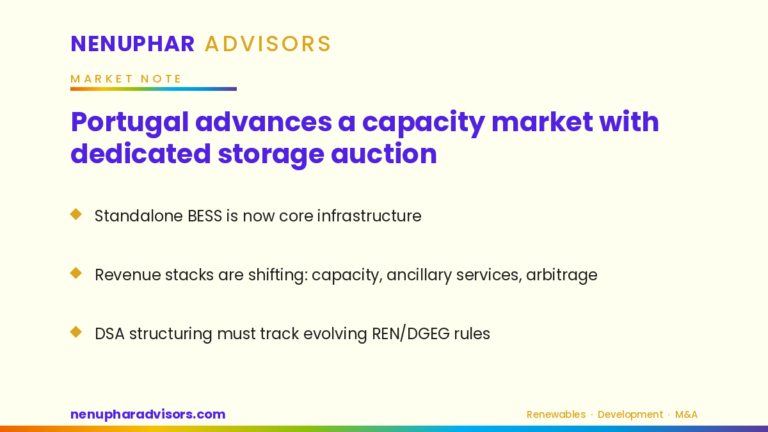
Portugal is close behind, with a capacity mechanism under development, open to generation, storage, demand response and flexibility, and a dedicated 750 MVA storage auction designed with a 75 percent renewable-charging requirement that favours co‑located renewable+storage projects. The Iberian blackout of April 2025 and the subsequent move to 15‑minute settlement have sharpened system demand for fast, flexible resources in both countries.
What this means for Iberian developers and investors
For Nenuphar Advisors, five conclusions stand out from this work:
– Cost is no longer the edge: Iberian LCOEs are among the lowest in Europe; competitive advantage now comes from captured revenue and firming strategy, not marginal capex optimisation.
– Hybridisation is the growth engine: PV/Wind+BESS hybrids share scarce grid connections, lift margins, and sit in the policy sweet spot in both Spain and Portugal.
– Standalone merchant BESS needs stacked revenues: The pure merchant arbitrage play is premature; robust cases pair storage with capacity payments, tolling or other bankable structures.
– Storage is cheaper than many models assume: European battery capex and LCOS sit well below US benchmarks, so using US numbers to screen Iberian projects risks underestimating value.
– Policy windows set the timing: The Spanish capacity market, EDRF grants, and Portugal’s capacity mechanism and storage auction define the actionable calendar for storage and hybrid projects over the next decade.
At Nenuphar Advisors and Nenuphar Frontier, we see Iberia moving from a cheap energy story to a dispatchable energy story, where value is captured by those who can combine renewables, storage, grid access and bankable revenue structures into coherent projects. If you are a developer, investor or lender active in Portugal or Spain and would like to explore what this means for your pipeline, particularly around PV+BESS, wind+BESS and hybrids on existing connection points, we are happy to talk.